Is A Vasectomy Painful? Not With His Choice No Cut Vasectomy!
If you have ever considered getting a vasectomy, one of the first questions that likely comes to mind is, “Is a vasectomy painful?”
The short answer is yes…to some degree but it is not as bad as you might thing
Many people expect the answer to be a simple reassurance that there is no pain involved.
However, we prefer to be honest with our patients. The reality is that nearly every man who undergoes a vasectomy will feel some level of discomfort at some point — whether before, during, or after the procedure.
Transparency is important to us. A vasectomy is not completely pain-free, but it is also far less uncomfortable than many men initially fear.
The His Choice approach uses one of the least invasive vasectomy techniques available today. Even with this modern method, though, a small amount of discomfort or sensitivity can still occur.
From a medical standpoint, vasectomy is a straightforward procedure that can be safely performed in a standard office setting. While we know the procedure itself is relatively simple, we also understand that the possibility of pain is usually the biggest concern men have when they start thinking about a vasectomy.
Almost all patients will report some pain when having a vasectomy. The reality is most patients will have a very low level of pain from vasectomy. In fact, we prefer to use the word discomfort because pain is too strong of a word to describe a His Choice Vasectomy.
Vasectomy: Definitely painful between the ears!
We often tell our patients, somewhat humorously, that a vasectomy tends to cause more stress in the mind than discomfort in the body. In many cases, the most difficult part of the entire experience is the anticipation and nervousness leading up to the procedure.
At many clinics, men are required to schedule two separate visits: one appointment for a consultation and another for the actual vasectomy. These visits are frequently scheduled weeks or even months apart.
That extended waiting period can give anxiety plenty of time to grow. Even if you normally handle stress well, it’s common for nerves to build as the day of the procedure approaches. By the time you wake up on the morning of your vasectomy — and especially when you pull into the parking lot — those feelings of anxiety can be quite intense.
For many men, the nervousness they feel beforehand can make them expect far more pain than they will actually experience during the procedure.
When you choose to have a vasectomy at His Choice, we make every effort to shorten the time between deciding on the procedure and actually having it performed. In many cases, patients are able to book a single-visit appointment, where everything is completed during one office visit. Reducing extra steps and long waiting periods helps lower the stress and worry many men feel beforehand.
Most patients find that once the procedure is finished, they realize the buildup and anticipation were far more uncomfortable than the vasectomy itself. The anxiety leading up to the appointment is often the hardest part, while the actual procedure tends to be much easier than expected.
Is the anesthetic used for vasectomy painful?
Many men report that the most uncomfortable moment of a vasectomy is when the numbing medication is given—particularly when it is delivered with a traditional needle.
At His Choice, patients do not need to worry about injections. The numbing medication is delivered using a needle-free technique.
Instead of a syringe, we use a small handheld instrument called a MadaJet. This device uses a gentle burst of air pressure to deliver the anesthetic through the skin of the scrotum. Most men say the sensation feels similar to a quick snap from a small rubber band against the skin.
Some patients initially describe this step as painful, but that reaction is often related to uncertainty about what the experience will be like. Anticipation and nervousness can make the moment feel more intense than it actually is.
The numbing medication begins working almost immediately and continues providing relief for several hours after the procedure is finished. Once the anesthetic gradually wears off, most men do not experience severe pain.
Instead, the typical description after a vasectomy is mild soreness or sensitivity in the area rather than significant discomfort.
Is the vasectomy procedure painful?
Most men assume that a vasectomy will be very painful. In reality, many are surprised to learn that the experience is often much easier than they originally expected.
To better understand how patients actually feel during the procedure, we surveyed more than 10,000 men who had undergone a His Choice vasectomy. About one month after their procedure, we asked them to report the amount of discomfort they experienced during their vasectomy.
Each patient was asked to rate their pain using a scale from 1 to 10, where 1 represented the least discomfort and 10 represented the highest level of pain.
When the results were analyzed, the average reported pain score was only 2.5, indicating that most patients experienced only mild discomfort during the procedure.
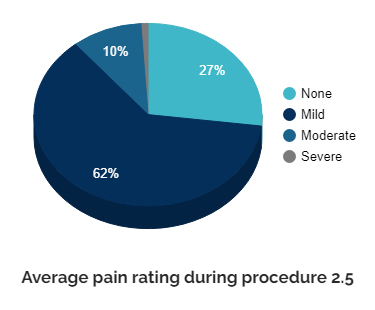
These results indicate that most men described the discomfort during their vasectomy as mild.
A portion of patients said they felt little to no pain at all during the procedure. Some reported a moderate level of discomfort. Only a small percentage of men—less than three percent—described their experience as severely painful.
Overall, the overwhelming majority of His Choice Vasectomy patients reported that they either felt no pain or only minimal discomfort while their vasectomy was being performed.
How painful is a vasectomy a day later?
Our patient data indicate that most men report very low levels of discomfort during the vasectomy procedure.
The nerves within the scrotum respond extremely well to local anesthetic medication. Once the numbing medicine is applied, these nerves are effectively blocked, allowing the procedure to be performed with minimal sensation. Even after the anesthetic gradually wears off—usually within three to five hours—patients typically do not experience a sudden surge in pain.
For this reason, we generally do not advise routine use of ice packs or frozen peas after the procedure. Many men are surprised to learn that icing is often unnecessary.
In most cases, any mild soreness that develops afterward can be easily managed with common over-the-counter anti-inflammatory medications, such as ibuprofen or naproxen. These medications are usually all that is needed to keep patients comfortable during the recovery period.
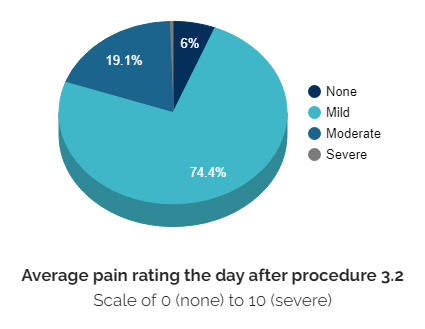
We also asked patients to evaluate how they felt the day after their vasectomy. In this survey, men were asked to score their discomfort using a scale from 1 to 10, where 1 represented very little pain and 10 represented the highest level of pain. The average score reported the day following the procedure was 3.2.
This indicates that, for most patients, post-procedure discomfort the next day was mild. Some men reported no pain at all, while others described a moderate level of soreness. Only a small percentage of patients said their pain was severe.
Overall, the majority of His Choice vasectomy patients experienced only mild discomfort the day after their procedure.
Recovery: How painful is a vasectomy recovery?
Many men are pleasantly surprised by how comfortable they feel after undergoing a His Choice vasectomy. While every patient will notice some level of soreness or sensitivity, the discomfort is usually mild and can typically be controlled with common over-the-counter medications such as ibuprofen, naproxen, or acetaminophen.
After the procedure, we recommend that patients return home and rest for the first 12 to 24 hours.
So what exactly does “resting” involve? In simple terms, it means limiting physical activity during that time. Patients should avoid repeated bending, heavy lifting, or any activity intense enough to cause sweating or strain.
We also suggest that patients take a single dose of an over-the-counter anti-inflammatory medication once they arrive home after the procedure. This typically means 800 mg of ibuprofen (four standard 200 mg tablets) or 440 mg of naproxen (two 220 mg tablets). For patients who cannot take these medications due to allergies or other medical reasons, acetaminophen can be used as an alternative.
After taking this initial dose, additional medication is usually only necessary if you feel you need extra relief for mild soreness.
Most of our patients do not require prescription-strength pain medication before, during, or after a His Choice vasectomy. Because discomfort is typically minimal, we are able to offer the convenience of single-visit vasectomy appointments. This simplified approach is also one reason many men choose to travel from other cities to have their procedure performed with us.
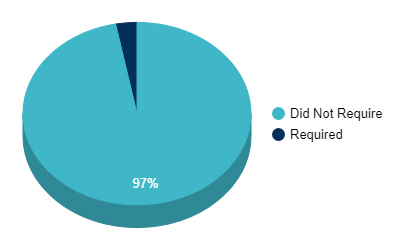
In the same patient survey mentioned earlier, we asked men whether they needed narcotic pain medication at any point during the first 30 days following their vasectomy.
More than 97% of patients reported that they did not need narcotic pain medications during their recovery.
We generally advise patients that they can return to normal daily activities—including sexual activity—about 48 hours after their vasectomy.
Vasectomy experience: Will vasectomy be painful?
We generally advise patients not to spend too much time searching the internet in an attempt to “research” their vasectomy. Online searches—and even artificial intelligence tools—cannot accurately predict whether you personally will experience discomfort or how your individual recovery will feel.
It is especially important to be cautious when relying on information from social media platforms. Much of the content shared online tends to highlight the most extreme or dramatic experiences. Influencers and viral posts often focus on unusual stories because they attract attention, views, and engagement.
The reality is that the typical vasectomy experience—where recovery is smooth and discomfort is minimal—rarely becomes a viral story.
We also suggest avoiding comparisons between your experience and that of friends or acquaintances who have already had a vasectomy. Every doctor uses slightly different techniques, and those differences can influence how the procedure and recovery feel.
For example, many physicians still perform a traditional vasectomy, which involves using a scalpel to make skin incisions that are later closed with stitches.
Complication rates tend to be higher with the conventional scalpel technique compared with the minimally invasive approach used in a His Choice vasectomy. Men who undergo the traditional method often report more discomfort during recovery than those who have a minimally invasive procedure.
It is important to remember that each individual’s experience can vary. To help patients understand how recovery pain may differ from person to person, we sometimes compare it to the way earthquakes are experienced.
Having a vasectomy is similar to an earthquake with aftershocks
Every patient will notice some level of discomfort at some stage of the vasectomy process. In many ways, the experience can be compared to an earthquake followed by smaller tremors afterward.
An earthquake is sudden and intense, but it usually ends quickly—often before you fully process what just happened. The vasectomy procedure itself is similar in that way: it is brief and over before most patients expect it.
Just as earthquakes vary in intensity, so do people’s experiences with vasectomy. Many earthquakes are mild and barely felt, while a small number are much more powerful. Recovery after a vasectomy follows a similar pattern.
The discomfort that can occur during recovery is often comparable to the small aftershocks that follow an earthquake. These sensations may appear intermittently and gradually diminish over time as the body heals.
Some earthquakes do not produce any aftershocks. Some earthquakes have serious aftershocks that will continue for days to weeks after vasectomy.
Usually over time the aftershocks decrease in severity. Not only do they decrease in severity but they also decrease in both magnitude, power, and frequency.
The same is true for episodes of pain after vasectomy and each person’s vasectomy experience will be different.
Most patients will have some ‘vasectomy aftershocks’. They will have episodes of pain that last for several hours to several days. Most importantly over the counter anti-inflammatory medications will help with these episodes of pain.
Overtime these vasectomy aftershocks will decrease and dissipate. Usually they have stopped by the time of the 3 month after vasectomy semen sample but in some patients these vasectomy aftershocks can continue to for up to 12 to 18 months after having a vasectomy.
In almost all patients these aftershocks are easily controlled with over the counter anti-inflammatory medications. They will eventually stop and not pose a serious problem.
Having a His Choice minimally invasive vasectomy will allow you to have a vasectomy in a single visit without sutures or needles and allow you to get back to your normal routine as quickly as possible.
For more information: His Choice Minimally Invasive No Scalpel Vasectomy
Is a vasectomy painful? Not with us!
Vasectomy does not have to be painful when you have your procedure with His Choice Vasectomy.
We encourage you to do your research, watch our videos, and schedule a single visit vasectomy with a His Choice vasectomy provider.
To see our locations visit: His Choice Vasectomy Locations